
How Arrest Warrants Work in Fillmore County
Behind every Fillmore County arrest warrant sits a signed order from a judge. Minnesota's criminal rules spell out what it must contain. The document names the defendant, states the offense, and directs an authorized officer to make the arrest and bring the person before the court promptly. Some orders also carry bond or release terms. That is why the warrant alone never tells the whole story in Fillmore County. It has to be read next to the case file. A summons, by contrast, gets the same defendant into court without an arrest.
Probable Cause Starts a Fillmore County Arrest Warrant
A judge in Fillmore County signs an arrest warrant only after finding probable cause. The finding rests on a sworn complaint, an affidavit, or a citation. A bare officer request will not do. Those papers describe what happened and tie the named person to it. When the paperwork runs thin, the judge can deny the warrant and order a summons instead. Two similar Fillmore County cases can therefore end on very different paths, all because of what the file contained.
Fillmore Arrest Warrants: What They Contain
A Fillmore County arrest warrant is not a separate register anyone can browse. Its details live in the Fillmore County District Court case file and the charging document. The fields below come from those sources.
| Defendant | The named person, with identifying details the Fillmore County court has on file |
|---|---|
| Offense | The charge, the statute, and the level of the offense |
| Basis | The complaint, affidavit, or citation that supports probable cause |
| Issuing judge | The Fillmore County judicial officer who signed, and the date of signing |
| Command to officers | The direction to arrest and bring the person before the Fillmore County court |
| Bail and conditions | Any amount set in the order and any condition attached to release |
| Return and execution | Entries showing service, arrest, or a change in the Fillmore County warrant's status |
Fillmore Charging and Warrant Issuance Roles
Three offices split the work in Fillmore County, and knowing the split saves calls. The Fillmore County Attorney prosecutes felonies, many gross misdemeanors and misdemeanors outside city limits, and juvenile cases. That office also advises police on charges. It does not confirm or clear warrants. The Fillmore County District Court issues each order. The Fillmore County Sheriff executes it. The prosecutor's desk is not a warrant counter.
How Warrants Get Served in Fillmore County
Serving warrants falls to the Fillmore County Sheriff's Office. That agency runs patrol, investigations, civil process, court security, and the Fillmore County Jail with about fifty employees, nineteen of them full-time deputies. Deputies also act as the law enforcement lead in Spring Valley, Wykoff, Ostrander, Harmony, Canton, and Mabel under contract. Chatfield, Rushford, and Preston keep their own departments. Those city forces may still assist.
Fillmore County Sheriff's Office
901 Houston St. NW
Preston, MN 55965
507-765-3874
Fillmore County District Court
101 Fillmore Street E.
Preston, MN 55965
507-765-6021
The Fillmore County Sheriff's Office page lists the divisions and the contracted cities.
Why Fillmore's MCRO Flag Is Only a Lead
Minnesota's online case system stamps an Active Warrant marker on a party, and state guidance warns the flag may belong to another case. So treat it as a lead. It tells you where to look, no more. Open the MCRO case records service and read the Register of Actions for the right case. Then call the Fillmore County court. Only that call confirms the warrant is still active.
Arrest Warrants, Summonses, and Bench Warrants
Minnesota courts use three instruments to pull a defendant into a Fillmore County courtroom. Which one they pick shapes everything about the first contact with an officer.
| Instrument | When a court uses it | What happens first |
|---|---|---|
| Arrest warrant | Probable cause on a charge, when custody is the chosen route | An officer may take the person into custody |
| Summons | Probable cause on a charge, when appearance by notice is enough | The person receives notice and appears on a set date |
| Bench warrant | A missed hearing, a violation, or an ignored court order | Custody and a prompt appearance, unless it is a sign-and-release warrant |
Prompt Appearance After a Fillmore Arrest
An arrest on a Fillmore County warrant starts a clock rather than ending the process. Minnesota's criminal rules say the person goes before a judge promptly. Older rule language put that at not later than 36 hours after arrest, or as soon as a judge is available. The first appearance is where bail gets set. Conditions are handled there too, if the warrant left them blank.
Fillmore Arrest Warrant in Your Name
Learning that a warrant carries your name is a moment to slow down. Minnesota court guidance says to talk to a lawyer before taking any step. Sequence matters here. A surrender planned in advance usually goes differently from an arrest on a highway. Fillmore County publishes no walk-in surrender policy. The terms have to come from the Fillmore County court itself.
Important: Call a lawyer before you call the Fillmore County Jail. A felony arrest warrant changes what happens at a first appearance, and counsel can often arrange the surrender on agreed terms.
- Confirm the charge, the case number, and any bail already set with Fillmore County District Court Administration at 507-765-6021.
- Ask whether a Fillmore County judge requires a surrender, a bond, or a motion before the warrant can be recalled.
- Contact a lawyer about arranging the surrender to Fillmore County and about the first appearance that follows.
- Do not miss the next hearing date once it is set, because a second failure compounds the first.
Fillmore Warrant Surrender: Ask a Lawyer
In every Fillmore County arrest warrant case, a lawyer is worth the call for practical reasons. Counsel can confirm what the judge actually wants. Counsel can request a return hearing, walk you through a first appearance, and explain what a bond will and will not do. Public defender screening and legal aid route through the Fillmore County court's contact list. Fillmore's own page lists a Rochester public defender number. A legal aid line appears there too.
Federal Warrants Sit Outside the Fillmore System
Fillmore County sits inside the federal District of Minnesota, and a federal arrest warrant never shows up in the Fillmore County case system. The U.S. District Court for Minnesota runs courthouses in Minneapolis, St. Paul, Duluth, and Fergus Falls. The U.S. Marshals Service covers Fillmore County through its Minnesota district. That office publishes no fugitive roster. Federal warrant data stays in restricted systems, and PACER finds public dockets rather than working as a warrant search. The federal court contact page lists the four courthouses and the Clerk's Office.
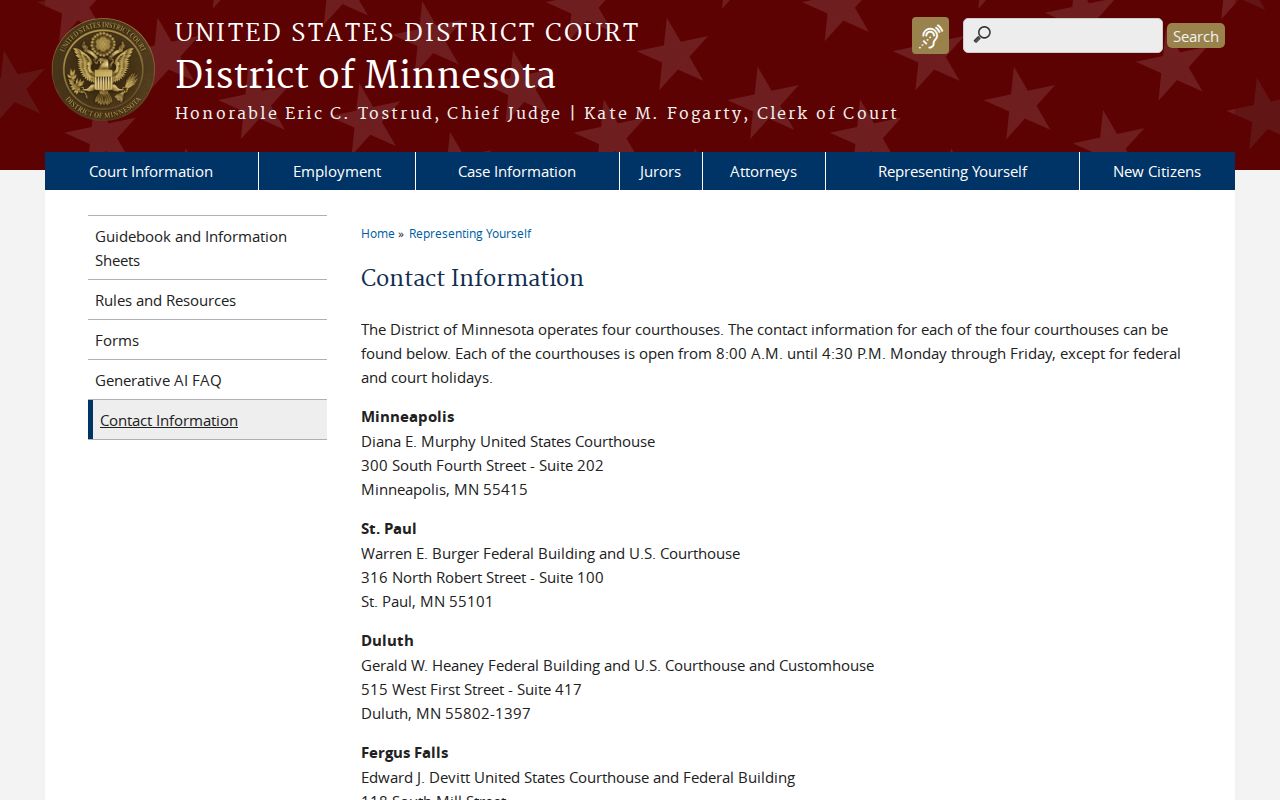
Federal warrants live outside the Fillmore County system. Confirm any federal matter with the federal court or your own counsel, not the Fillmore County District Court.